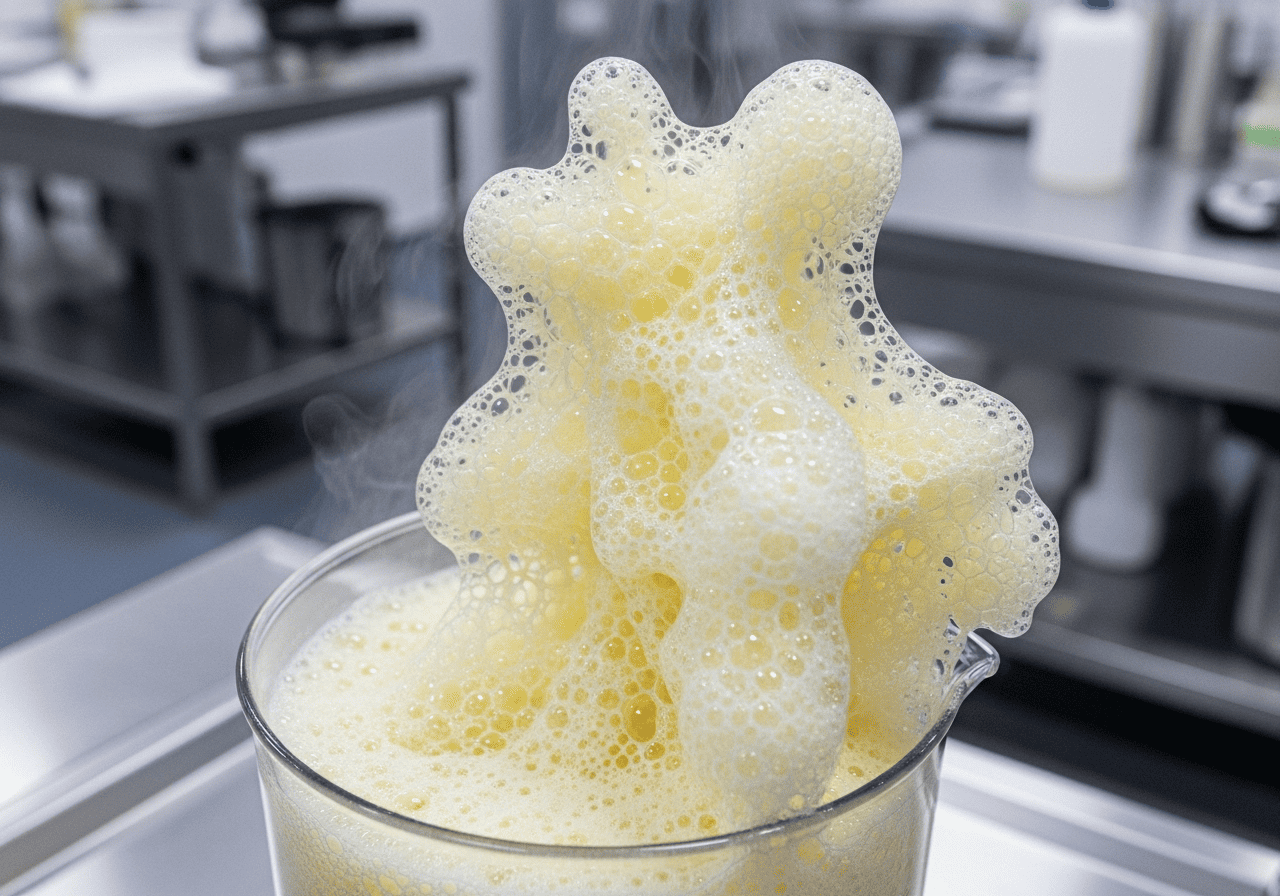
Polyurethane foam control solutions
The role of the uniform foaming agent is to ensure that newly generated tiny bubbles do not rupture or merge, achieving the required uniformity in cell size and distribution of the final foam, and maintaining the stability of the foam system throughout the entire process from foaming, transportation, heating and curing to final molding.
Related Products

BD-3367
Silicone Surface Control Agent, Silicone Surfactant, Leveling Agent

BD-3467
Silicone Leveling Agent, Polyurethane Coating Leveling Agent, Polyurethane Uniform Foaming Agent

BD-2104
High Resilience Foam Stabilizer, High Resilience Foam Uniforming Agent, Cell Size Regulator

BD-2158
Modified silicone oil, polyether silicone oil, foam stabilizer
Technology Details
Outlook
In polyurethane foaming processes, polyether-modified silicone plays a key role as a foam control aid (uniform foaming agent).
Due to the "one-pass" characteristic of the uniform foaming agent in polyurethane foaming processes, there are special requirements for the precision of its foam control effects, such as cell diameter size, uniformity, density, open cell rate, skinning, and other physical outcomes. Upon entering the system, the uniform foaming agent first emulsifies isocyanates, reducing interfacial tension between components, promoting the formation of uniform and stable mixtures, and laying the foundation for subsequent uniform reactions. It then assists in bubble nucleation and accumulation during chemical or mechanical foaming processes, where the uniform foaming agent provides foam stabilization, creating isolation between cells to achieve uniform cell size and density. Subsequently, before polyurethane (soft foam systems) crosslinks and forms, it partially or completely bursts bubbles, causing local or extensive cell interconnection to prevent collapse due to gas contraction during cooling, while also leveraging this principle to achieve slow rebound (memory foam) effects. Finally, the uniform foaming agent must ensure no damage to the skin, making the skin firm and glossy. Therefore, selecting a uniform foaming agent requires multiple compatibility tests and adjustments. It is best to achieve "one agent per formulation" for various recipes.
Additionally, considering environmental friendliness, more processes are now adopting mechanical foaming, which imposes higher requirements on uniform foaming agents.
Typical Cases
Mechanical Foaming Polyurethane Foam Control
Mechanical foaming disperses air (or other gases) into the reacting liquid polyurethane system through high-intensity physical shear forces to form microcellular foam. The role of the uniform foaming agent is to ensure that newly generated tiny bubbles do not burst or merge, achieving the required cell size and distribution uniformity in the final foam, and maintaining foam system stability throughout the entire process from foaming, conveying, heating, curing, to final molding.
BD-3695 and similar uniform foaming agents are a series designed specifically for mechanical foaming polyurethane foam control. Their performance features include: efficient microbubble regulation with more uniform micropores; excellent foam stabilization; low VOC; good compatibility; non-hydrolyzable structure. They offer better cost-performance than foreign brand products.
Lightweight Polyurethane Shoe Material Foam Control
BD-2104 and BD-2158 are designed specifically for low-density shoe material uniform foaming. They provide excellent microbubble regulation and foam stabilization, achieving microporous elastomers with densities as low as 0.25-0.35 g/cm³, maintaining high resilience and abrasion resistance while significantly reducing weight.
Foam Control for Foam Products, Including Polyolefins, Polypropylene, Polyethylene, Ethylene-Vinyl Acetate Copolymer (EVA), etc.
These products have diverse materials but similar foaming mechanisms. BD-3367 and BD-3467 uniform foaming agents are recommended. These two products have proven excellent versatility and outstanding performance in microporous foamed elastomer processes.